
Optimise for chaos. Take risk.
My Graduation Speech for the University of Sydney CompSci Class of 2026

I had the honour of being invited to deliver graduation address for the University of Sydney Faculty of Engineering Computer Science graduation ceremony this year and I wanted to share it here.
I’ll admit I was little surprised when they asked. In my experience, these address usually go to accomplished, late career alumni or guests. I felt woefully under-qualified. But apparently, these days inviting my more recent alumni makes the speech more relevant and accessible for the graduates which is fair enough.
Given I’m only a little further down the path, I wanted to focus on one core message that helped me in my unusual career for the grads; Take risk. Be ambitious. Think of ignorance as your superpower – Build with passion and ignorance paired with ambition to make a positive impact.
Half of the room were the parents. The other half, graduands. I found myself wondering how many of those parents wished they’d taken more risk early on. Quite a few, it turned out as several came up afterwards and told me exactly that!
Onto the speech (edited for readability);
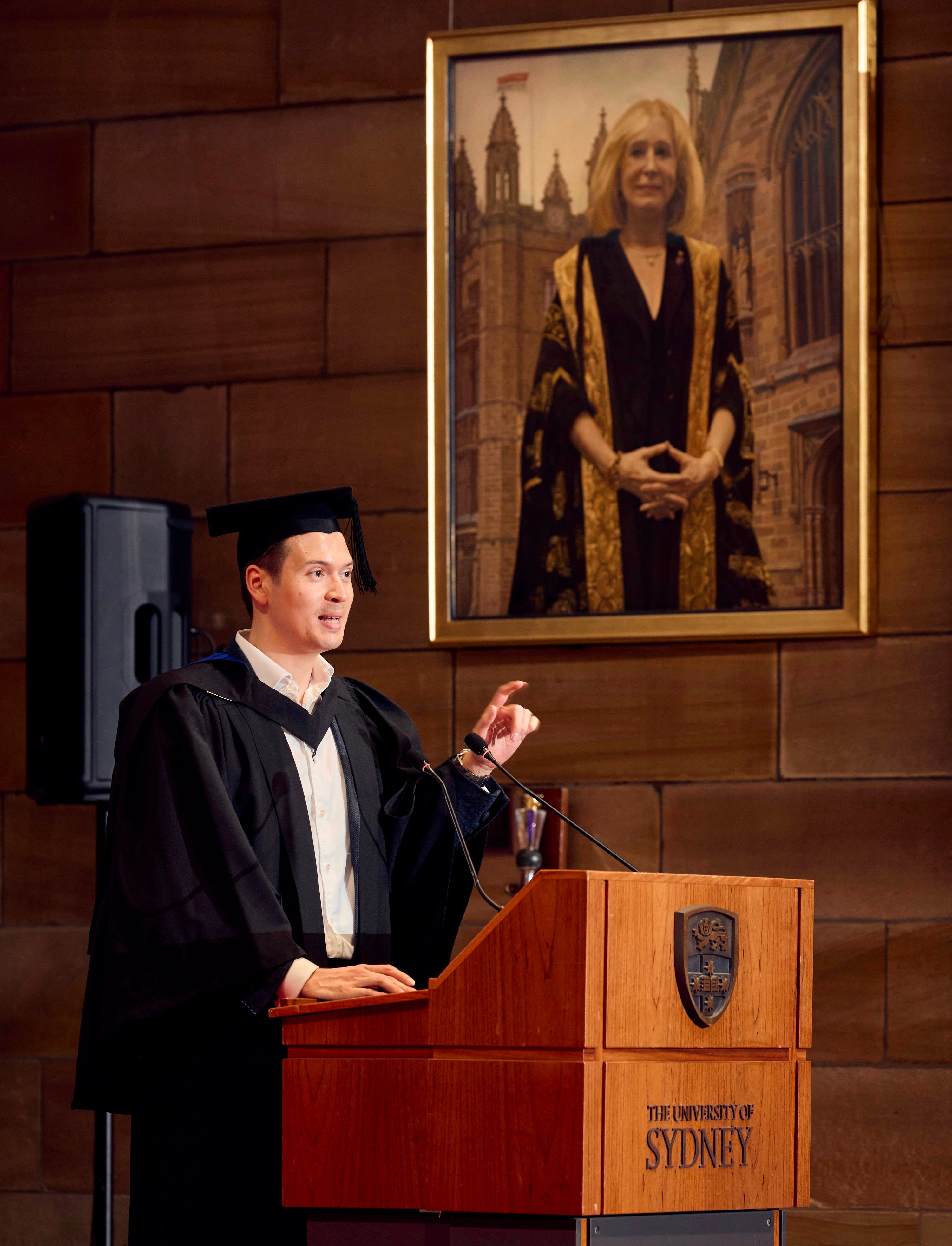
Graduation Address
Thank you for the kind introduction Pro-Chancellor and the opportunity to deliver the occasional address for the graduating class of 2026. To the graduands, families and friends in the room, Good morning.
“How hard could it be?”
That simple question I’ve asked myself at almost every major turning point in my career. And I’ll be honest, the answer looking back has usually been, ‘pretty bloody hard’. But thats a good thing as I’ll explain.
I’m sure many of you are sitting there right now feeling anxious about what comes next. What to do, where to go, whether you’re making the right choices. You’re not alone! I’m still asking myself the same questions. I’m just further along the road.
I’m standing here not as someone with a finished career, I’m in the middle of mine, still building the plane mid-flight as they often say in startups. I co-founded a venture capital firm, Galileo Venutres, backing the next generation of tech founders, many of whom are changing the world building new technologies.
You might ask how on earth a CompSci grad who nearly dropped out in first year ended up in tech finance — well, that’s kind of the whole story.
My backstory
Let me take you back to 2008. First year CompSci. And it was, by any measure, a complete disaster. I had to repeat multiple subjects including 3 Unit maths, I had trouble learning to code and I didn’t make any new friends. After first year uni I was about to drop out..
What changed was joining SUITS (now SYNCs) which led me to ‘find my tribe’. Becoming President of the ‘Nerd Society’ (as I call it) was a defining moment for me. Me and my fellow execs helped build a community for CompSci students on campus, hosting events, the infamous weekly free BBQ and playing Mario Kart in the SUITS room between classes. Many of these people have become life long friends I still hang out with today.
It was on a SUITS company site visit that I got my first break. Between boring banks and trading firms, we ended up at Atlassian. Immediately you could tell the office atmosphere was different. This was a startup.
I sat next to a sweaty guy eating a sandwich after lunchtime basketball. I asked who he was: “I’m the CEO.” This was of course Scott Farquhar the former co-CEO.
Back then they were about 120 staff, no external funding, selling software to the top 500 companies in the world. He said to email him if we wanted an internship. I was the only person who followed up.
My first real ‘tech job’ was as an intern software engineer at Atlassian and it was an eye opening moment. You had a small startup that no one heard of that sold software globally all from Australia.
I wondered why, a) there weren’t more software companies hiring engineers and b) no one was talking about this incredible business.
When opportunity strikes, act. I wasn’t the smartest person in that room. I was just the only one who sent the email.
That became a bit of a theme.
In my last year of university I somehow ended up editing the country’s oldest student newspaper, Honi Soit. Recruited as the ‘tech guy’, which mostly meant they wanted me to build a website, as was a classic outsider in a room full of aspiring editors and writers some of whom you probably read and see everyday in our biggest newspapers or on TV.
But it led me to write a feature on tech alumni from USYD, which sparked conversations that led to something bigger — starting Incubate, Australia’s first student tech incubator.
The two questions I kept asking
We ultimately helped kickstart startup programs across five universities and supported over 200 tech startups from the ground up. Incubate became my training ground for building companies and supporting entrepreneurs from all backgrounds and degrees. I saw first hand how it changed their lives and opened doors they didn’t know existed. But it also revealed flaws in the modern education system which often incentivises students to take the safe path, not building something of value.
Incubate changed how I saw the world. I realised I enjoyed supporting founders but became passionate about building this tech sector in Australia and the infrastructure to fund and back the next generation of founders.
I wanted to fix this.
And it left me with two questions I couldn’t shake:
Why is it that the founders who have the biggest impact are almost always first-timers — outsiders, not insider experts?
Why is it that at the exact stage of life where you can take the most risk — we as a society encourage you to take the least?
I didn’t have answers yet. But I had an idea.
‘How hard could it be?’
Starting a Venture Capital Firm, Galileo Ventures
The VC venture capital sector used to be a cottage industry of a few funds on Sand Hill Road in Silicon Valley but has become a global sector. When I started Incubate there were virtually none, or couple at most, active VC funds in Australia.
So with zero background in finance and zero experience in venture capital — but with genuine insight into what early founders needed and the passion to back them — my co-founder Hugh Stephen’s and I started pitching investors to give us capital to start a VC firm.
The response? You guessed it. Crickets.
No one wanted to give us money. My favourite question I got during our first fundraise was: “are there actually any good startups coming out of Australian universities? (Aka. Young people start good companies?)”
It took us nearly three years to raise that first fund. Three years of rejection, of learning on the fly, of being outsiders in a world that didn’t particularly understand us. But through dogged persistence and not giving up (and healthy dose of swallowing our pride), we eventually found the right investors and partners and got there.
Fast forward to today — our first fund has 25 investments and currently ranks in the top 5% of VC funds globally. We’ve backed first-time, what we call emerging founders, building global companies from Australia in AI, robotics, software and deeptech. Some of the founders we’ve backed are changing their industries and building world changing companies, like Relevance AI, Andromeda and Tixel – all started by graduates just like you. We’re now onto our second fund and backing more emerging founders with global ambitions.
We were outsiders who had to learn on the fly. Sound familiar?
What I figured out
Which brings me back to those two questions.
Why are the founders with the biggest impact almost always first-timers — outsiders, not experts? The companies many of you aspire to work for — Microsoft, Meta, Google, NVIDIA, Atlassian, Canva — were all started by first-time founders with little experience and enormous ambition. I think it’s because imagining the world differently requires and probably necessitates that outside perspective.
Expertise can be a cage. Ignorance can be a superpower.
And why, at the stage of life where you can take the most risk, do we encourage you to take the least?
Get a stable job, get a mortgage, optimise for career safety. Well — I’m here to tell you that’s bullshit.
Optimise for chaos; Explore opportunities where you have genuine insight and passion. Embrace volatility. Have no expectations and cultivate raw ambition. Ignorance paired with the drive to have a positive impact through new technology is one of the most powerful forces for change there is.
Now let me zoom out for a moment. I want to tell you why I’m genuinely excited for you.
We’re at the start of the next industrial revolution, one that will likely lead to a new renaissance in how we organise society. It will happen gradually over our lifetimes but it will change how you think about work, enable you to achieve more than your parents could have imagined, and see you work alongside a new form of intelligence.
The impact will be profound. And you, as graduates of computer science, are at the epicentre of it.
Australia is no longer a tech backwater. We’re now the second biggest industry in the country, employing over a million people and growing fast. We drive most productivity in Australia. We sit between east and west, and our distance — once seen as a disadvantage — is increasingly our edge. AI will turbocharge our ability to do more with less, and that will have an outsized effect on a country that is already the most capital efficient producer of tech unicorns in the world.
The opportunity is here. And it’s now.
Welcome.
Before you go
So I’ll leave you with this.
If you already have unique insight into an opportunity and feel the itch — go for it now.
If you want to help build something great, go find the most talented team you can and learn everything you can from them.
And if you don’t know what you want to do yet — that’s okay too.
In a nod to the hill climbing algorithm: it turns out that randomly dropping yourself into new environments and trying different things is actually the optimal strategy for figuring out which hill has the highest peak worth climbing.
Go forth with passion and ignorance, paired with ambition to have a positive impact. Build something the world doesn’t know it needs yet.
Thanks for listening.